Dante Meets Virgil: A Medici Tapestry

Updated: Jul 29
The Meeting of Dante & Virgil, Designed by Francesco de Rossi Salviati, Woven by Jan Rost & Workshop; Florence, Italy, now in Minneapolis Institute of the Arts, 1546-49
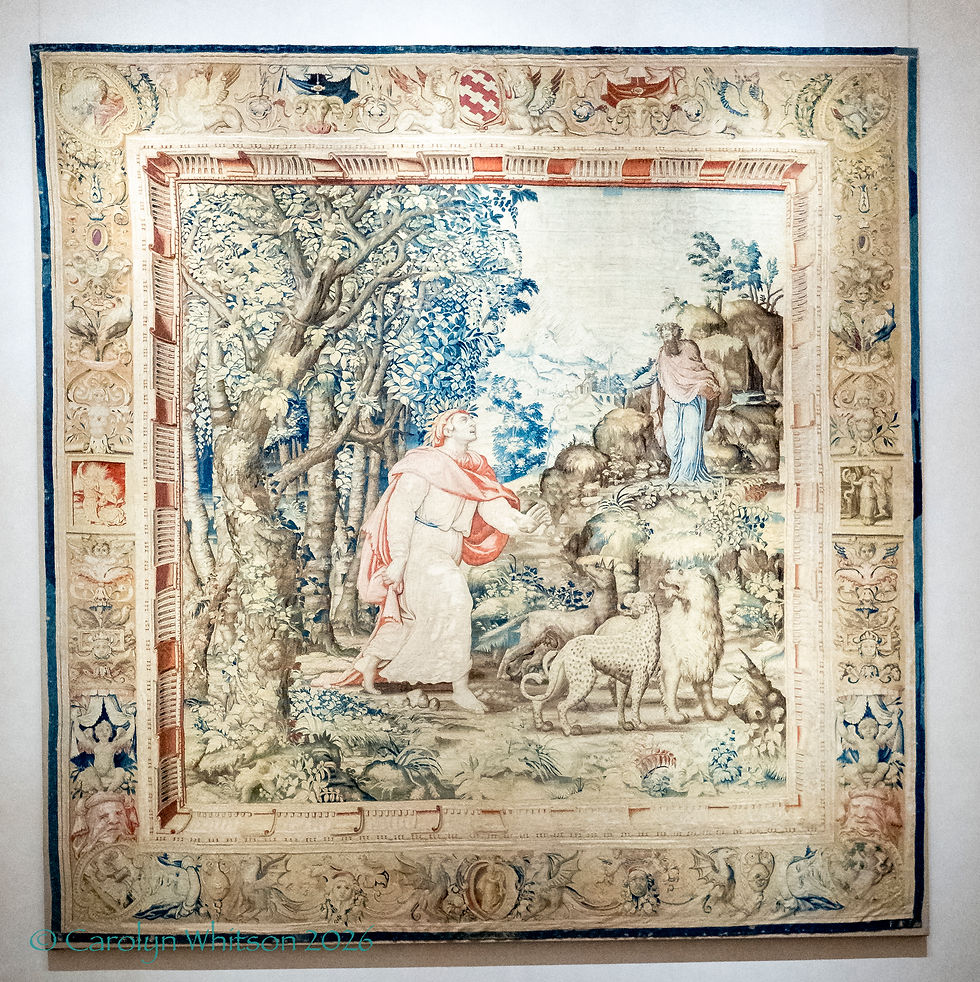
A rare and special object is on display at my hometown museum: the Minneapolis Museum of the Arts is exhibiting its own tapestry of Dante Meeting Virgil, from 1549. It was a product of an elite tapestry workshop owned by Cosimo de' Medici, fashioned at every step by top artists with the finest materials. Max Bryant, the museum's curator of European decorative arts and sculpture, asserts without reservation that it is the most important Italian Rennaisance tapestry in the United States (take that, Met NYC, Chicago, Philly, Boston, & Getty!). It hasn't been on display in over 60 years due to its fragility and its need of restoration. But Bryant and talented museum staff (with a grant from the TFAF Museum Restoration Fund & the Bank of America Art Conservation Fund) have resolved those issues, making it possible to display the tapestry for a short time.
So, here is what we are lucky enough to see: in silk, wool, and vibrant dyes, a rendering of a scene from Canto I of Dante Alighieri's Inferno, from the Divina Commedia. Here, Dante, in the middle of his life, finds himself, metaphorically and in the tapestry, wandering in a dark wood. He encounters three beasts: a she-wolf, a lion, and a leopard. They symbolize the three classes of sin within Hell which he and Virgil will witness: sins of incontinence or lust, represented by the she-wolf; violence against nature or others, represented by the lion; fraud and malice, represented by the leopard.
At this moment in the poem, Dante cries out for help and Virgil appears, stilling the predators from their menacing of Dante. Dante gazes up to see who has saved him, and sees his literary hero, Virgil, though he doesn't recognize him instantly.
Dante is about to embark on a journey through Hell, Purgatory, and Paradise, in order to rescue his soul from error. His path to salvation is instigated by his childhood friend and mortal ideal of feminine Divine Love, Beatrice di Folco Portinari, who dwells in Heaven. She is too pure to guide him through Hell, so she enlists Virgil to engage Dante and show him the wages of sin throughout Hell, then guide him up the heavy, penitent climb of Mount Purgatory to the gate of Heaven, where Beatrice can take over his rescue.
Before the instance of this scene in the poem, Dante is aware of his fall from grace. He sees Mount Purgatory, and takes the first steps directly toward it. In the moment of this tapestry's scene, he is disabused of the thinking that he can take the straight path to redemption. He is blocked by the beasts, who symbolize both his sins and Sin in general. Virgil emerges, holding a blazing red book of his poetry (presumably, the Aeneid), and announces he must travel with him another way, through Hell, in order to reach his final destination.
Why should Virgil, born before Christianity, be the one selected to guide Dante through a Christian conception of Hell? Because Dante, well educated in Classical literature and philosophy, believes Virgil to be the apex of human reason, as well as the best Italian poet who ever breathed. Dante's mind and spirit have strayed from focus on his Christian soul, and they have instead immersed him in the world of literary achievement and politics. At the time of the setting of the poem, he is a man famed for his courtly love poetry, and infamous for being exiled from Florence for being on the wrong side of a civil war, falsely accused financial corruption. The fictionalized Beatrice selects Virgil not only because he is a resident of Hell, living in the first circle, Limbo, where the virtuous pagans, whose only sin is being born before Christianity, dwell, but also because Virgil can reach Dante intellectually, where his understanding of Divine Love resides at the beginning of the poem.
When you first take in the tapestry as a whole, it is, intentionally perhaps, overwhelming. The depth of field is remarkable, rendered of course in thread, rather than paint, which is far more difficult to execute. The border is a carnival of mythical beasts, small tableaux, a coat of arms, and multiple framing borders.
The interior scene has a rich and impressive use of depth of field, with foliage that appears on the verge of growing out over the frame and onto the floor of the room. This depth of field is all the more remarkable because the medium is weaving, rather than paint, where the illusion of depth is far more difficult to execute.
In the foreground is Dante, unmissable as he practically hovers in the center of the composition. He is the brightest feature in the composition in his light-colored tunic, with his mantle in varying shades of crimson, and his famous chaperon, topped with a poet's laurel crown. (I don't have any information about the original colors of the tunic, but it seems to be the same thread color as the subject's skin tone.)
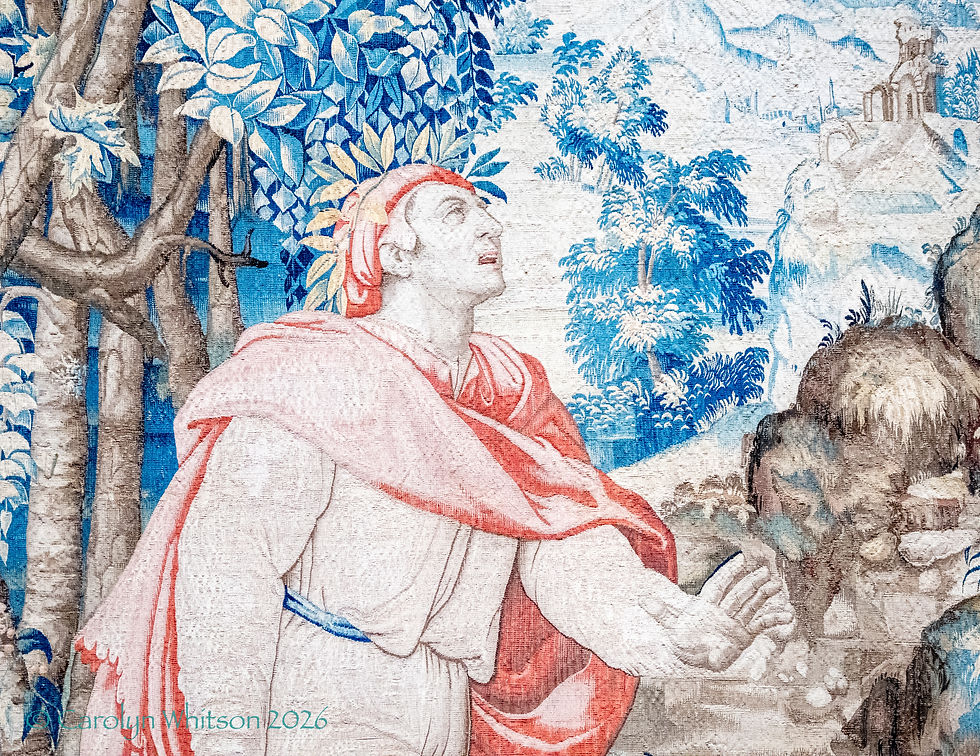
Francesco de Rossi Salviati, designed the cartoon, or image, which the weavers worked from. He was a court artist for Cosimo de' Medici, and made the design for de' Medici's workshop. What's intriguing about this image of Dante is that it doesn't follow the then-legendary and standard portraits of him. This Dante lacks the lantern jaw and aquiline nose. Also, his gaze does not track to where Virgil is. I think this, however, is an aesthetic choice. Given the placement of Virgil to the upper-right background, Dante's face would be two-thirds turned away to suggest a technically realistic gaze, and the audience would lose any dramatically compelling view of the character's face. So, it makes some sense to have him in profile, where a fuller expression would provide more emotional interest.)
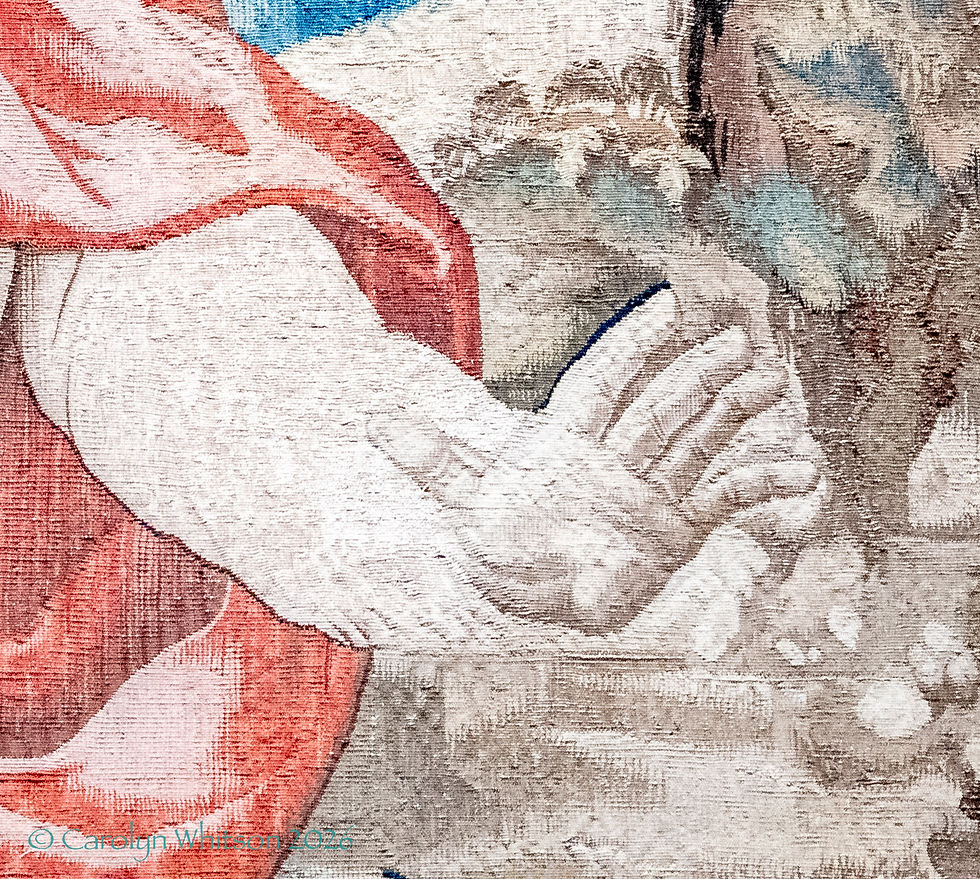
This close-up of Dante's hand, extended to ward off the three beasts, allows you to appreciate the efforts of the weavers to create depth and detail in the main figure. The hand is slightly too large to be in scale with the rest of the body--not uncommon in sculpture, but I haven't noticed it as routine in medieval/renaissance tapestries (though I'm no expert). The shading around the outline of the palm of the hand and the right-most two fingers suggests that the sun is behind Dante (which, indeed it is, but time and exposure have faded to near-invisibility the brilliant sunrise that was woven to appear above the mountain tops in the background). The heavy dark-blue stripe of color outlining the index finger could have been designed to make the hand "pop" with extra contrast from the forest floor background.

The delicacy of the back foot in the composition deserves its own close-up. Like the hand, the foot has contrasting thread to keep its definition clean: red to distinguish it from the pale crimson robe, and brown to define it more strongly from the light colored robe in front. The foot really does appear to be in the act of lift-off in this part of the scene. Salviati has given us a different take on contrapposto: where many/most instances of art portray it as a frontal pose, Dante is shown doing it in a side-view. He's not merely walking, his torso is twisted toward the viewer as he shifts his weight to his forward foot. This kind of contrapposto would be a bit trickier to produce in a sculpture.
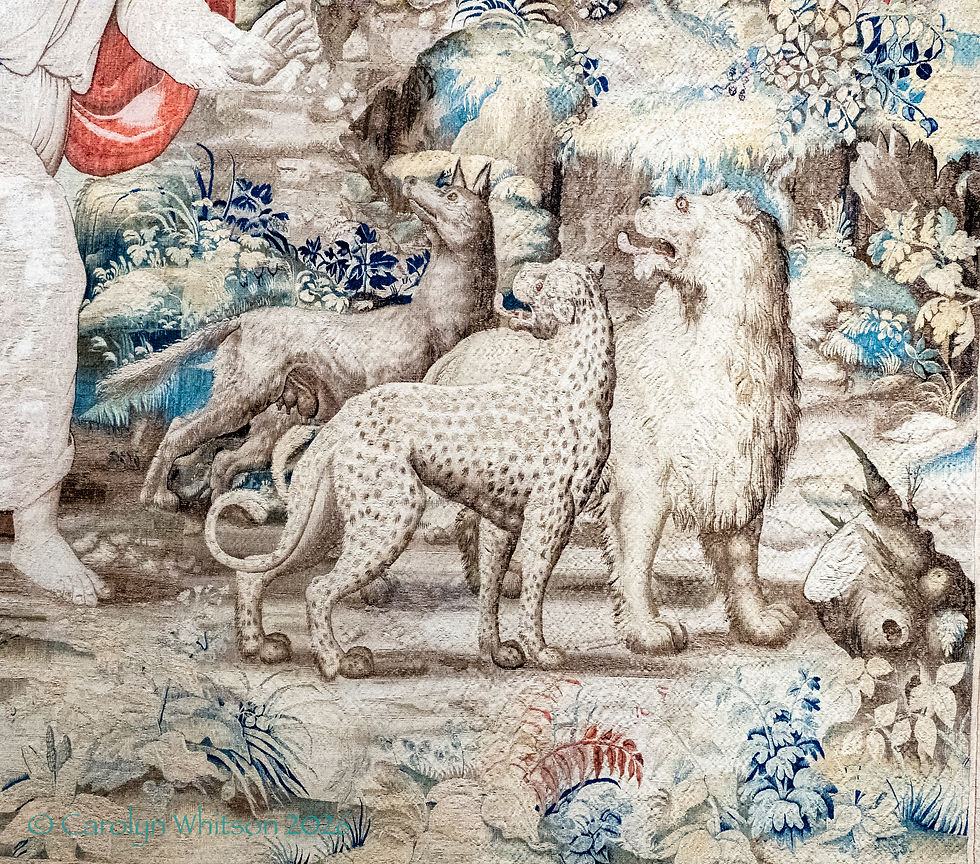
My chief quibble with the design of the tapestry is the depiction of the three beasts. In the poem, they are monstrous. They represent Sin, for pity's sake! In the tapestry, they are the size of house-pets, and it looks as though Dante has given them the command to stay. They are awaiting their treat in return for their obedience. ("Who's a good boy?!") Look at the image above and try to un-see what I have just described. I dare you! Nevertheless, the skill in representing the beasts is superb: Three different types of fur. Different muzzles, ears, paws, torsos. The she-wolf has very authentic-looking teats. The lion is exactly as inaccurate as your average medieval/renaissance rendering of a lion is. All eyes are realistically attentive. Bravo. But it's not at all convincing that these creatures were deterring anyone from a path moments before the scene of this tapestry.
Compare:

Image above from manuscript made by Priamo della Quercia and Giovanni di Paolo, early 15th c., Digital Dante Project

The image of Virgil, though smaller than that of Dante, is richer in detail. Like Dante, he has his laurel crown, marking him as a poet of tremendous renown. As MIA Curator Max Bryant describes in his excellent lecture, Virgil's blue tunic is has a rippled effect which looks like running water, echoing the description of him by Dante, "And are you then that Virgil, you the fountain that freely pours so rich a stream of speech?" (translation by Allen Mandelbaum). Behind Virgil a stream of water pours from a cave opening in a small cascade over rocks. Virgil's left hand holds a book, probably the Aeneid, an epic poem which also tells the story of its hero's descent into the Roman-envisioned underworld. Virgil's poem will be alluded to many times in structure, imagery, and theme in the Inferno. In a clever foreshadowing, the tapestry illustrates the book's cover as picked out in red and orange threads to look like flames.
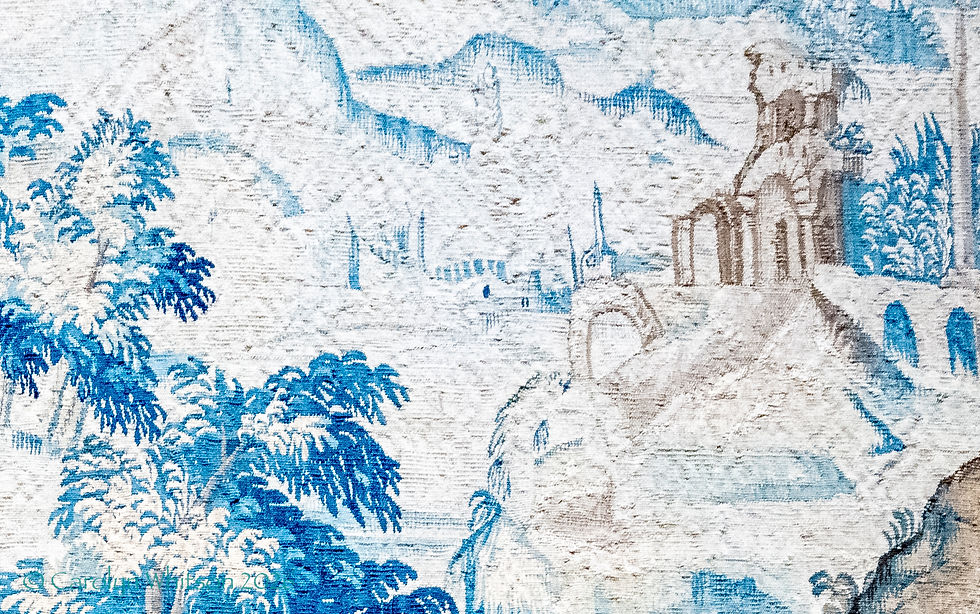
With his right hand, Virgil gestures toward the ruined landscape. The imagery suggests Roman ruins nearby, and a hilltop city in the distance. There are towers, churches, and monumental buildings on the hills in front of the mountains. The tapestry makers have done a masterful job here of using the brown threads to pull the ruins forward with brown thread, and to place the city and mountains farther away with blue threads, creating the illusion of atmospheric perspective.

Details which cry out to be appreciated, but which may be difficult to do so in person, are things like the foliage and wood, which use shading and different colors so well to convey a sense of reality, even though blue is not a natural color for a forest. Blue was, however, a very expensive dye, and would have shouted "luxury!" to the viewer seeing it, if they missed how much silk thread went into the tapestry. Tapestries were a decidedly prestige item with which to decorate one's palace --they were much more expensive to produce and purchase than paintings.
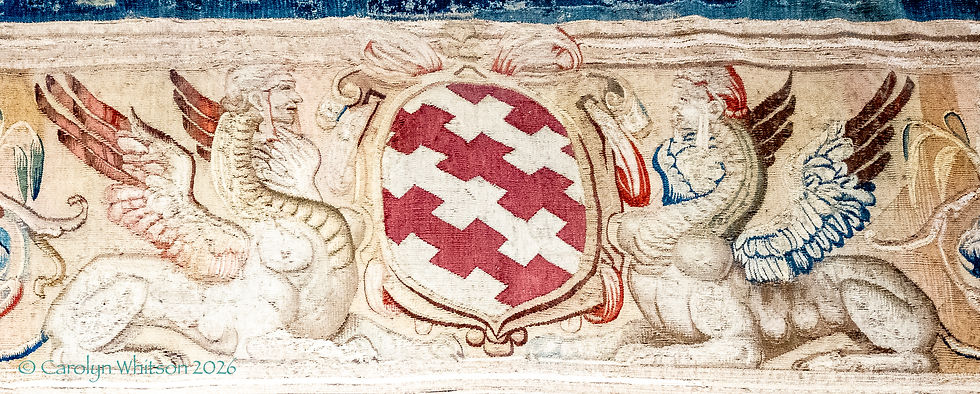
Delights you could miss in the tapestry include the many mythical creatures in the borders. Here, two sphinxes support the Salviati coat of arms.

This sphinx, near the others, has attractive blue wings and a fetching bonnet. I am puzzled by the way its breasts are tucked into its flank.
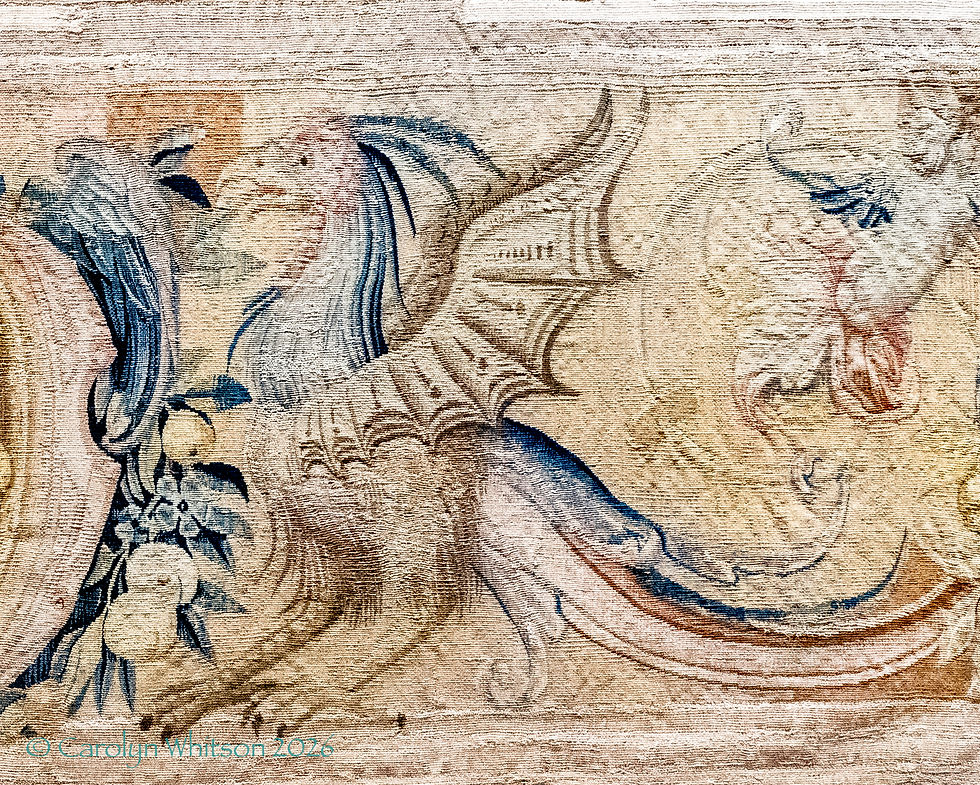
Here we have a basilisk. It's much faded, alas. I think its head and tail-feathers would have had more brilliant crimson to them back in the day.

Its buddy basilisk has retained more of its brilliant blue, but has lost some of its threading in its face.

A rather exhibitionistic putto presents himself here.

This arabesque panel has a lot of faces associated with it, and it appears that none of them want to be seen with each other. I've never witnessed so much eye-rolling and grimacing in one image of European art before, say, Caravaggio.

And, an arabesque with a rather angry ram's head. Just because.
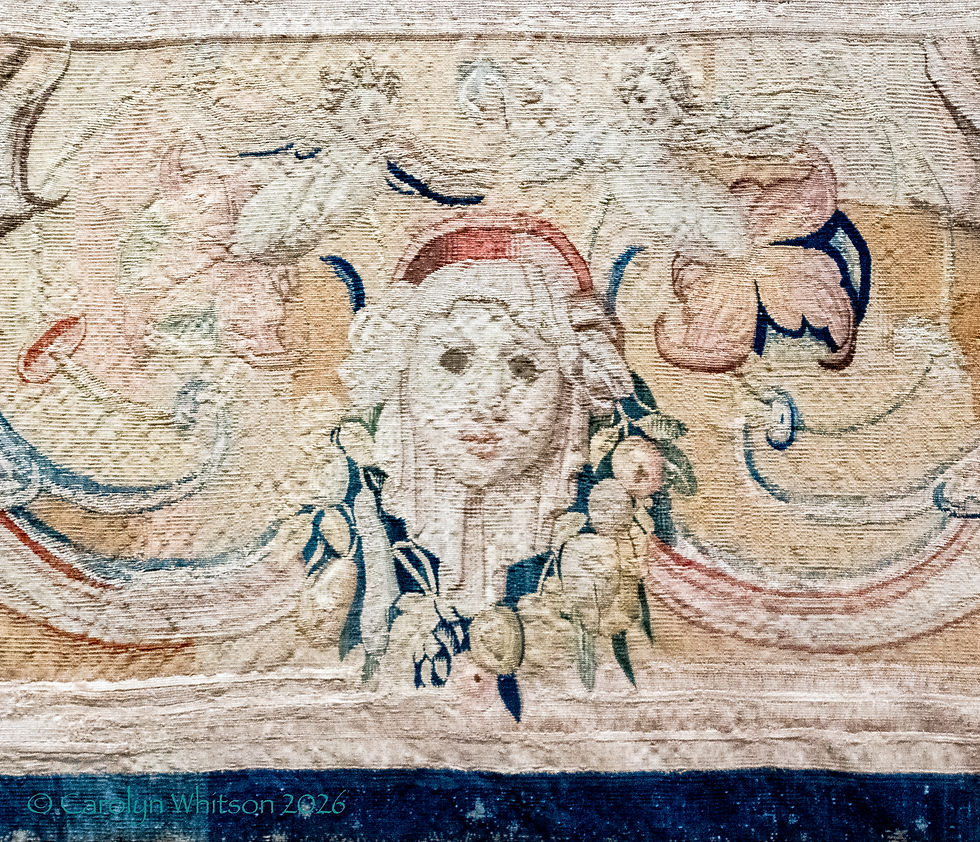
This mask made out of a piece of draped cloth is creepy, but you ain't seen nothin' yet.
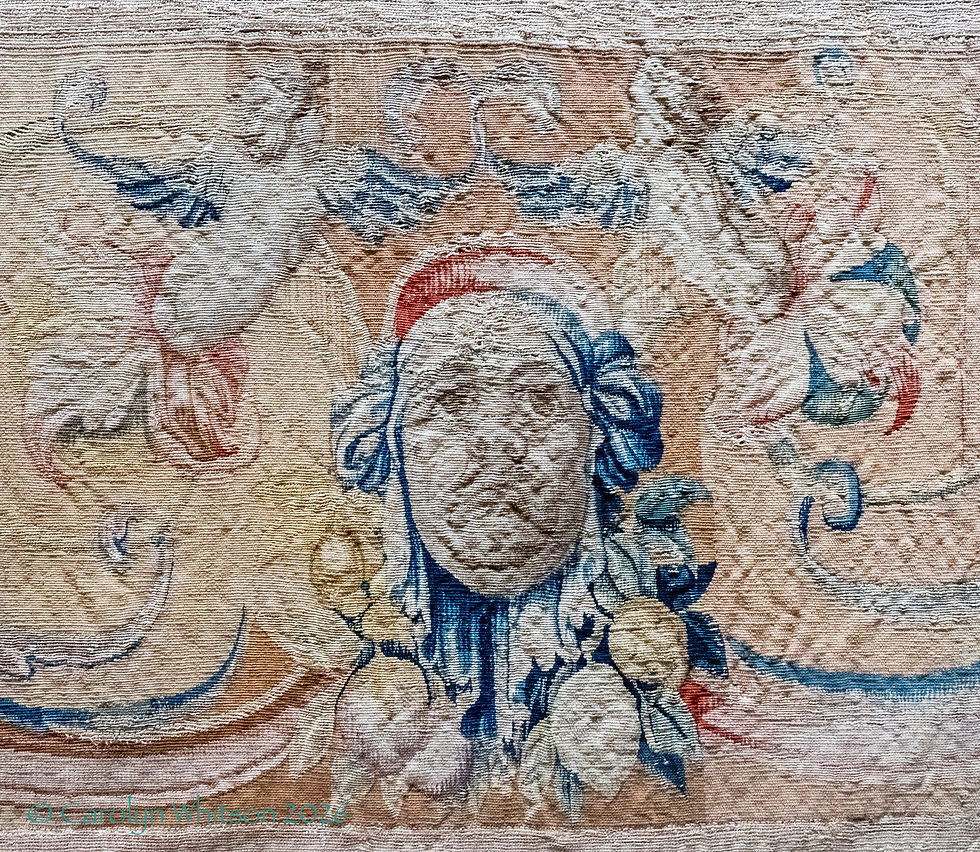
Nope. This isn't very creepy. It's a mask that has a near-portrait-like level of detail, but is probably here for some sort of orientalist exoticism. It's lost a lot of it's threading, but still very compelling.
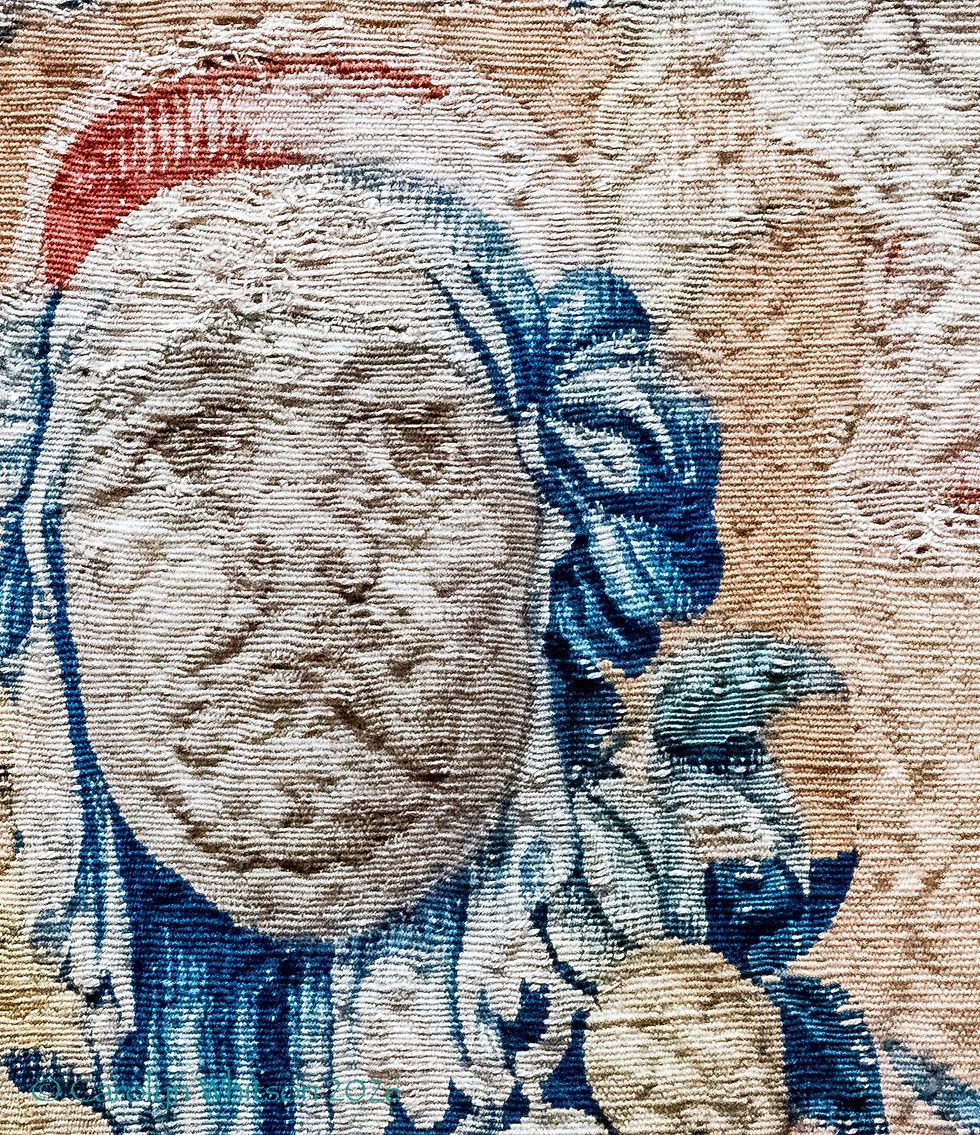
Worth the extreme closeup. The figure is jowly, but I don't think it's a caricature.

Here is the very creepy grotesque. These are doughy, nearly shapeless faces, woven to appear to be made with baggy cloth, the ends knotted to wear a chaperon. They look either drunk or dead. They flank a medallion with a reclining reader inside it--one of three. Are they all reading the Inferno or the Aeneid?
On the border at the bottom you see a stick design. It is, no kidding, a spit, on which a chicken is being roasted. This is the maker's mark of Jan Rost, the Flemish master weaver of the workshop. When you have a visually memorable name, don't fight it, I guess. Powerful branding.

This is the other creepy set of sack-face grotesques in the opposite corner, with another leisurely reader in a medallion. At the bottom right is the signature of the workshop itself: it stands for Made in Florence, in Latin, with the lily of Florence (distinct from the fleur-de-lis by its decorative stamens). The "F F" stands for "Made in Florence" in Latin, with the Lily of Florence (distinct from the fleur-de-lis by its decorative stamens). This mark indicated that the tapestry was a product of the Arazzeria Medicea--the Medici tapestry workshop.
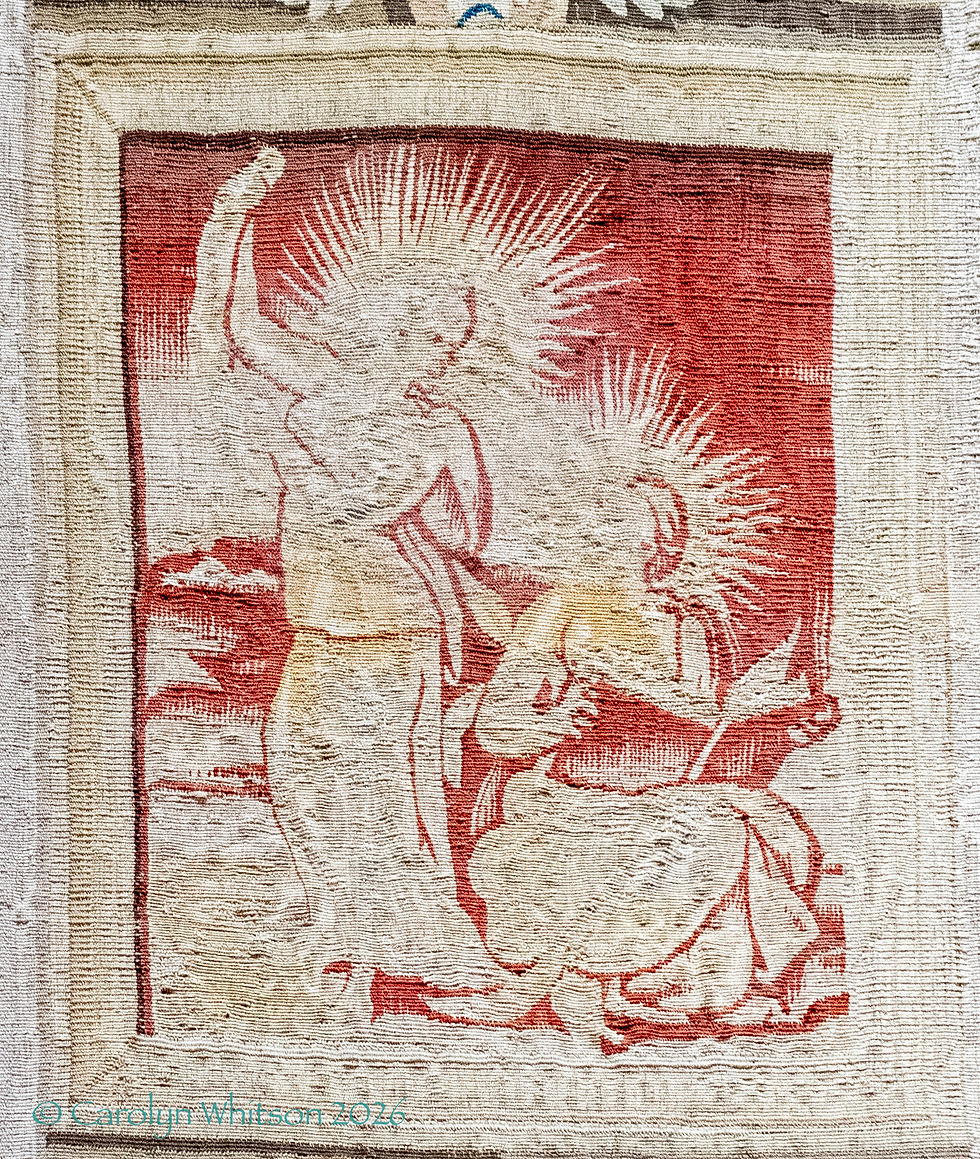
There are a tableau panels in the tapestry that are enigmatic, to me at least. The one above seems like a muse of inspiration engaging a reader. That would fit in with the theme of the two poets meeting, without me going too far into outrageous theorizing. Too bad about the loss of detail.
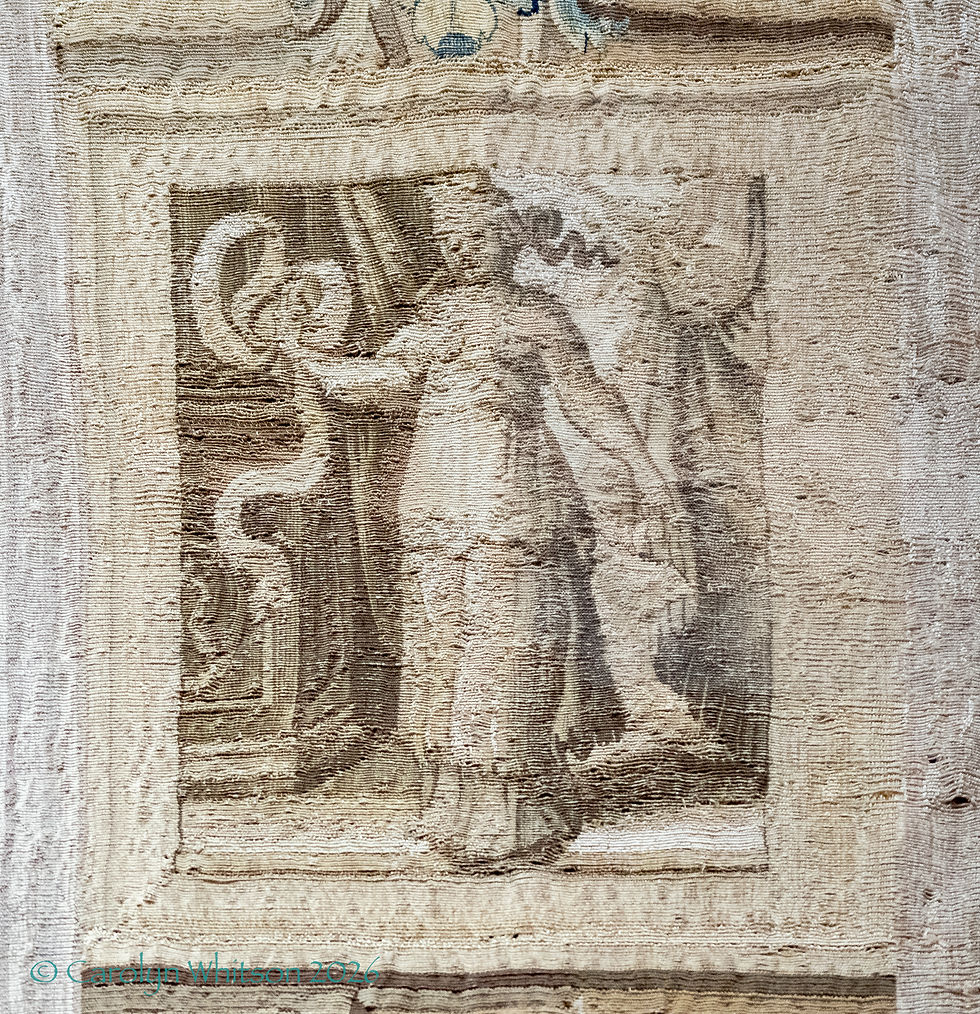
This one, too, has a female figure, appearing with a kind of nimbus of light behind her. She has a banner in her right hand, but it contains no words. So, nothing momentous here, but she makes about as much sense as the weird masks and the sphinxes.
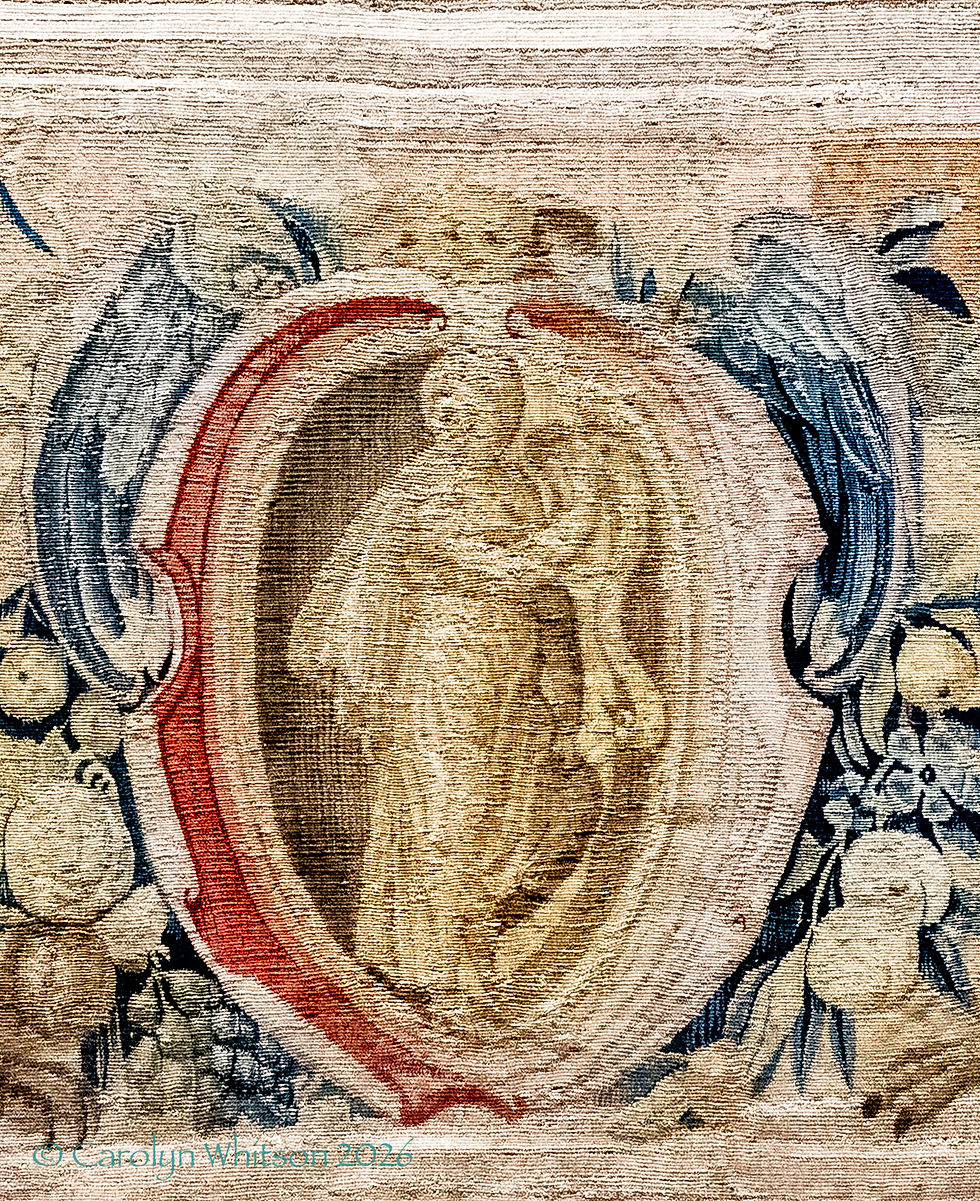
This third one has lost some of its detail in the face, so figuring out its significance is even harder. Still, we have a female figure in a golden light, bearing what may be another banner. She may be some sort of muse, because she, like the others, is in vaguely Classical dress. The overall border seems to be more for entertainment than symbolic direction in supporting the central subject, though, so it's all good if you're entertained.


Reading slowly, this is big stuff. Lovely illustrations and photographs, thank you.
Mother God, I'd forgotten Beatrice was that. The Catholics are very good with nice Mommy god. Some day I will figure out the difference in intercession and femme nurture/consolation and the Holy Spirit's alleged and so-called feminine talents in that regard. (Shekhinah, pillar of fire, leader out of hell, also thought of as feminine by Judaism scholars.) Holding the Aeniad as he begins guiding a tour of hell. So good.