A Man's Gotta do...But Why This? Part 2 Hercules' Labors and Other Problems


Hercules, with help from Hermes and Athena, steals Cerberus from Hades
Our hero has three remaining labors before he is freed from his servitude to King Eurystheus (and, by extension, Hera). If you missed Part 1, with the preceding labors of Hercules, you can read it here.
Hercules fights the Giant Geryon, Mosaic Floor, 26 CE, National Archeological Museum of Spain, Madrid

This task on which King Eurystheus sends Hercules is yet another suicide mission. As well, it's another adventure in poaching luxury livestock. Geryon is a three-headed and -chested giant who lives on an island at the edge of the Western world. So, the journey itself is part of the ordeal. The island is located close-by where Helios brings his chariot down to set the sun, and it's the proximity of this intense light that stains (tans?) the hides of Geryon's oxen a deep red.
The vases above and below here are a bit in tension with the variants of the story, because most written sources assert that Hercules opts not to fight Geryon in close combat because of the giant's incredible strength. (Fun fact: Geryon is the grandson of Medusa.) Both artists, the mosaicist and the vase painter, decided it would be more fun to depict Hercules bashing an entity with three sets of armor.
In the surviving written versions, the consensus is that Herc uses those very handy arrows dipped in the poisonous blood of the hydra, taking out the heads one at a time from a safe distance. But what fun would that be to put on a vase or a floor?
Hercules fights the Giant Geryon, 510-500 BCE, British Museum

Being the protagonist, Hercules kills Geryon and rounds up the cattle for transport. Once he is back in his own land, Hercules has a run of bad luck. The fire-breathing giant Cacus has decided to steal the stolen cattle himself. It takes awhile, but Hercules finds out where the cattle are, kills Cacus, and tries to round them up. Unfortunately, the cattle are spooked and scatter in various directions. Hercules rounds up most and delivers them to Eurystheus, who is satisfied that the labor has been done.
Below is a sculpture in the Garden of the Monsters, commissioned by Prince Orsini. It is of Hercules besting Cacus. It stands about 15 feet (approx. 5 meters) high.
Hercules fights Cacus, sculpted by Simone Moschino, late 16th c. Garden of the Monsters, Bomarzo, Italy

The penultimate labor for Hercules is to steal the golden apples from the Garden of the Hesperides. These last two labors are the "do-overs" Eurystheus requires because he didn't like how Hercules handled the cleaning of the Augean Stables nor how he killed the Hydra. The Hesperides are nymphs who are probably (long story) daughters of Zeus. Also in the garden, the Titan Atlas holds up the sky. Atlas tells Hercules that he'll get him some golden apples if he'll shoulder the sky for a while. With his amazing strength, Herc is uniquely qualified among mortal heroes to do this.
Below, you can see Atlas walking off as Hercules dutifully shoulders the starry burden. Note the outline of his Nemean lion helmet, which looks more than a little like the head of Bill the Cat from the "Bloom County" comic strip.
Hercules gets tricked by Atlas while stealing the Golden Apples, 5th century BCE, British Museum

The mosaicist has decided to keep Hercules front-and-center in every panel showing the labors, so we're off-script, with the man himself stealing the apples, as the nymphs cower behind the tree.
Hercules steals the Golden Apples, Mosaic Floor, 26 CE, National Archeological Museum of Spain, Madrid

Atlas tries to trick Hercules into holding up the sky forever (it's a punishment from the gods for the Titan), but Hercules tricks him right back, and brings the golden apples back to the King. The apples are sacred to Hera, it turns out, so Eurystheus does not get greedy (for a change), and hies the apples right away back to the goddess' temple.
In King Eurystheus' last labor for Hercules, we're back to trying to get Hercules in deadly disfavor with another god--Zeus' brother, Hades. The task is to steal his dog, the gate-keeper of Hell, Cerberus. Having been around this block a few times, Hercules knows that, when it comes to gods, it is not better to ask forgiveness than to ask permission. Thus, he goes straight to Hades and Persephone to state his case. They agree, but the dog must be returned promptly. Also, no subduing Cerberus with weapons; bare hands only.
All this is successfully concluded with relatively little drama. Athena and Hermes keep Hercules from getting lost, and supply him with a leash that will keep Cerberus a good, calm boy.
Hercules steals Cerberus, 560-550 BCE, Villa Giulia National Etruscan Museum, Rome
In the vases above and below, you can see that Cerberus has only two heads. Apparently, there is dispute in the ancient records over how many heads he had.
Hercules Steals Cerberus, 490 BCE, British Museum

Below, you will see two examples with the more standard (to modern readers) three-headed representation of the dog. I like how the Louvre version of Cerberus has a head in a different color for each: white, black, and red. If you look very closely in all three of the vases, you'll see that Cerberus' mane is made of snakes (his parents were the Echidna and Typhon, both sea serpent creatures), and his tail is a snake. He's like a second cousin of a chimera.
Hercules Steals Cerberus, 530 BCE, Louvre Museum

In the scene above, you can see Hercules bringing Cerberus back to King Eurystheus, who is terrified, and only too eager to agree that, yes, Hercules has completed all the labors and the dog can go back now. Right now.
Hercules Steals Cerberus, Mosaic Floor, 26 CE, National Archeological Museum of Spain, Madrid

So, we end the labors with this mosaic, with arguably the cutest little Cerberus I've seen. He looks like a puppy, and at least one head is reluctant to leave home. I like how Hell is connoted by a claw-like rock over-hang.
Hercules as a sarcophagus motif, 160-170 CE, Villa Borghese, Rome

The 12 (well, 14) labors of Hercules in both Ancient Greece and Rome, represented a kind of excellence in physical masculinity and determination. They were, as you've seen in these two blogposts, reproduced prolifically over several hundred years. Many of the vases were found in the graves of elite men. Loved ones may have included images of Hercules as a reflection of greatness they saw in men they'd lost, or because the figure was admired by the decedent.
Hercules has numerous other stories about him. Some of which no written record survives. The two pieces below represent a very popular one. At some point, in the tales of the hero, he fights Triton, the son of Poseidon and Amphitrite.
Hercules fights Triton, Etruscan, late 6th century BCE, Louvre Museum

The only descriptions I've found about the fight are vague discussions that these images may have been a means by which to assert that Hercules had mastery over the sea as well as the land, but why? Why did that need to be affirmed?
Hercules fights Triton, 525-500 BCE, Louvre Museum

A consistent theme in stories about Hercules (outside his problems with Hera, which initiate the labors) is his problems with women.
Hercules serves as the sex slave of Queen Omphale, Mosaic Floor, 26 CE, National Archeological Museum of Spain, Madrid

Above, we see Hercules as the slave of Queen Omphale. After Herc accidentally (which means in a drunken or altered rage) kills a friend, he is sold into slavery and the Queen buys him. She requires that they cross-dress, and he performs women's chores (like spinning thread (seen above) and keeping the household. She gets to wear his lion skin and use his club as a sceptre. By many accounts, they were in love and happy for years. They had sons together. What to make of this surprising contradiction of his otherwise very macho feats of derring-do?
Hercules fighting Achelous as a Snake, 1824, Francois-Joseph Bosio, Louvre Museum

At a different point in his life, getting toward the end, in fact, Hercules seeks to marry. He vies for the hand of Princess Deianira, and has to compete with a river god named Achelous, who is a shape-shifter. He might have thought twice about her--her name means something like "husband destroyer," and it does work out that way. But, she's hot, and above and below we see two forms of the river god.
Above, we see Hercules bashing Achelous as he turns into a giant snake. He seems completely unfazed by the shapeshifting and he bests the god in this form. But the river god is not through. He shifts his form...
Hercules fights Achelous, 5th century BCE, Louvre Museum

In this vase from the Louvre, Hercules fights him as a bull-man (Not the minotaur--that was Theseus). In the fight, Herc breaks of one of Achelous' horns, which becomes the cornucopia.
Hercules wins Deianira, and they marry, but it's not a marriage without problems. She's very desirable, and he has to keep fighting for her.
Hercules fights Nessus the Centaur, 44o BCE, British Museum

The centaur Nessus carries off Deianira and attempts to rape her. Hercules, contrary to what's shown on the vase, kills Nessus with those trusty hydra-blood-tipped arrows of his. Before dying, Nessus tells Deianira to save some of his blood and put it in a garment for Hercules to wear--it will ensure his fidelity. Not the brightest bulb, she does so.
Hercules is given poisoned garments, 430 BCE, British Museum

In a paraphrase of Chekhov's gun principle, one cannot introduce the idea of a magic blood-stained garment in act one without it being worn in act two. On this vase, we see poor Hercules, shedding his protective lion hide, and accepting from Deianira (or a servant? no one is sure) the Nessus' blood-soaked garment. As you might have guessed, the garment covers Hercules' garment in a searing poison so destructive that the gods must beam him up to live forever with them in Olympus or he would die in agony. That's a happy ending. I guess.
Hercules and Geras, 500-450 BCE, Villa Giulia National Etruscan Museum, Rome
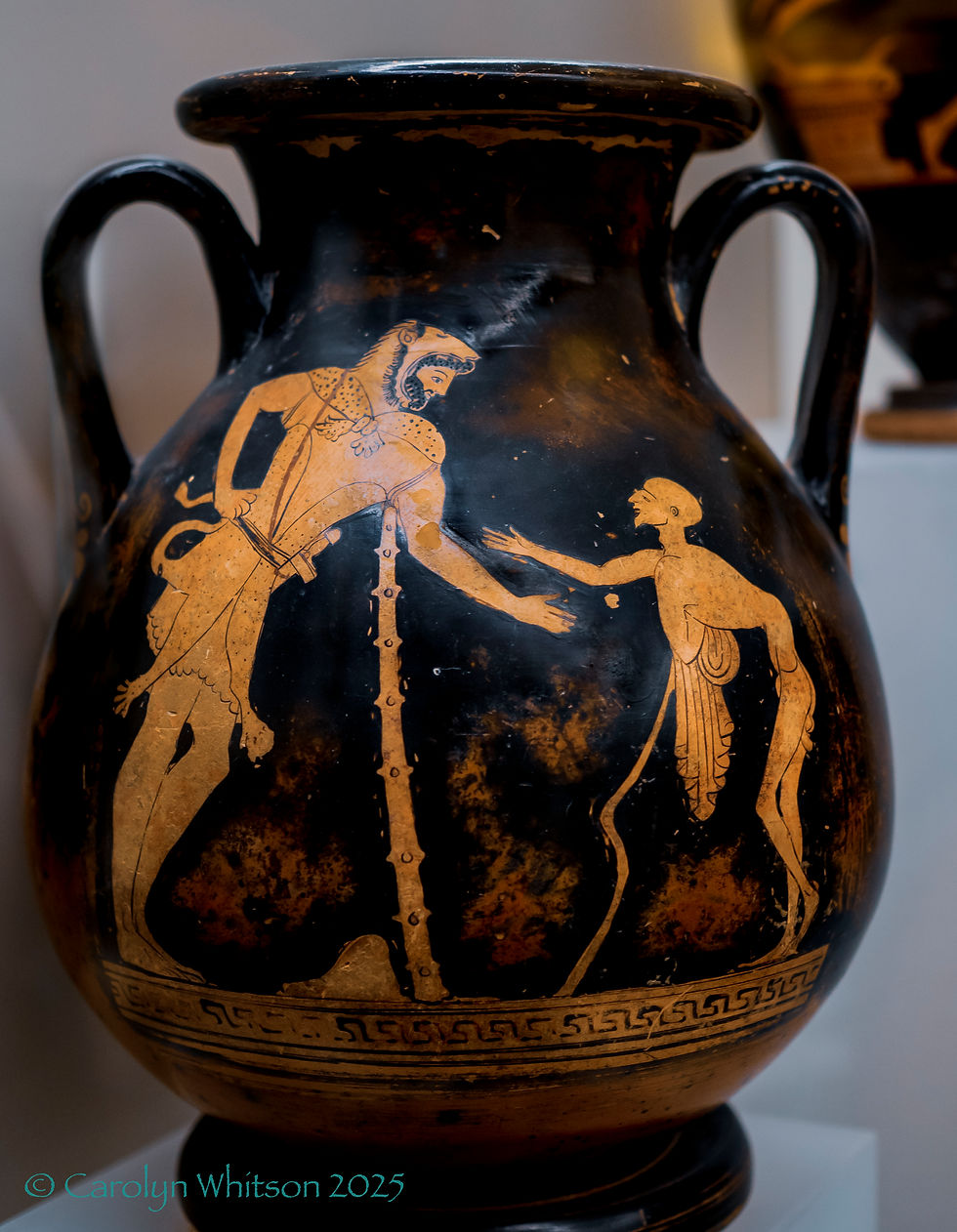
Hercules fights Geras, God of Old Age, 480-470 BCE, Louvre Museum



Reading about Hercules’ labors reminded me that life often brings challenges we never expect. During my college days, I struggled academically and sometimes felt overwhelmed by difficult subjects and deadlines. Now, as a PhD student working part-time at the affordable assignment, those experiences inspire me to help others facing similar difficulties. I have learned that patience and persistence matter more than perfection. Even a Computer Science Assignment Service reflects a broader need for understanding and guidance.
I recently started using a grade calculator and it has completely changed how I track my academic progress. Instead of guessing my final scores, I can now accurately estimate where I stand in each subject. This helps me plan better, stay motivated, and focus on areas where improvement is needed.
This post made the later labors of Hercules feel vivid, especially the mix of strength, trickery, and help from the gods. When I studied Greek myths for a history class, I remember reading similar stories late at night while using Health Care Assignment Help to keep up with other subjects. The details about Atlas and Cerberus stood out to me the most. It shows how these myths were not just about power, but also choices and consequences.