A Man's Gotta Do...But Why This? Hercules and His Labors, Part 1

Updated: Dec 18, 2025

Hercules serves as the slave of Queen Omphale, mosaic pavement, 26 CE, National Archeological Museum of Spain, Madrid (discussed in next part, but pretty nice for a banner)
I cannot think of any other Ancient Greek character more of a draw for trouble than Hercules. Beside Hercules, Odysseus is a slacker; Theseus and Perseus--choirboys. In the many stories where he is the hero, he is mortal (though a demigod--one of the earliest Marvel Universe-style heroes in Greece perhaps), but he achieves apotheosis, and develops a very real cultic following with temples across the Mediterranean from Cadiz to Antioch.
There's no settled gospel of Hercules. Most print versions of myths (in English, anyway) are derived from the surviving art, which is abundant, and varied. What no one disputes is that the man was set with impossible tasks from cradle (literally) to grave, and most of the time he had to use his bare hands to deal with the messes set before him. He uses a club instead of a nobleman's sword, just to underscore his humble status. One could think of him as a patron god of the working man--the guy who always has to get his hands dirty, and gets little reward except to get up the next day and do it (in some form) again.
Hercules Stealing the Delphic Tripod, 470-450 BCE, British Museum

Versions disagree on whether Hercules brings punishment down upon himself or is a victim of a jealous wife's revenge. The jealous wife would be Hera, Zeus' spouse and sister, who despises Hercules as physical proof of her husband's adultery. Patriarchy being what it is, she can't take her wrath to the person responsible, but she can menace a mortal child. In that version, Hercules is a hapless victim, who proves himself virtuous in his strength. Another strain of the tales suggests that Hera tricks Hercules into madness, during which he murders his wife and children. To atone for this atrocity, he is punished with the 12 labors. Somehow, not only does his success clear him of the pollution of the crime, but it will also deify him.
Above, Hercules is depicted as a young man. After he murders his family, he goes to the Oracle at Delphi to ask the Pythia how to atone for his crimes. At first, she refuses to answer him. In a completely unforced error, he picks up the tripod the Pythia sat upon to receive the vapors which gave her the prophecies, and makes off with it, intending to get his own answer. On the reverse of this vase, he is chased by an angry Apollo. They fight, and Zeus breaks it up with a hurled thunderbolt. Herc gets his answer, in having to serve King Eurystheus for 12 years. The king works with Hera to cook up deadly, humiliating, and/or provocative tasks which should end up with the man dead or destroyed.
Hercules and the Nemean Lion, early 6th c. BCE, Museum of Potenza, Basilicata, Italy

The first labor is for Hercules to slay the Nemean lion. Sounds simple enough, save that the golden pelt of the lion is impermeable to weapons. Herc tries arrows and a sword, but eventually Athena (who bails him out often in these stories), suggests that he use one of the lion's own claws to stab him. I haven't taken a survey, but in my limited experience, I've found more representations of Hercules slaying the lion than any other labor, and I think it's because everyone loves to look at cats (and draw them). So, here are four examples, from four different major museums. These are only vases. I could have included little bronze figurines, big sculptures, and sarcophagi (there's one of those in part 2).
Hercules and Nemean Lion, 560-540 BCE, Getty Villa

Hercules and Nemean Lion, circa 500 BCE, British Museum

Hercules and Nemean Lion, 510 BCE, British Museum

As you can see, Hercules usually has supporters on the sidelines. In the first example, Athena is on the left, but in the last two she is on the right, sporting her aegis, made of Medusa's head and hair. The one above is handsomely snakey. On the left is probably Iolaus, Hercules' nephew, who holds his weapons and accompanies him much as a medieval squire would do. After the first labor, Hercules wears the skin of the lion as his impenetrable armor and artists down the centuries have a great time figuring out ways to drape it over his shoulders, tie the dangling legs as a belt, discreetly cover his naughty bits, and use the maw as the opening of a helmet. It may well be the ancient West's most popular fashion accessory.
Hercules and the Hydra, Mosaic Floor, 26 CE, National Archeological Museum of Spain, Madrid

The second labor was for Hercules to destroy the Lernaean Hydra, which dwelt by one of the entrances to the Underworld. The cave of the Hydra was filled with the poisonous fumes it emitted. The beast itself possessed several heads, one of which was immortal. If one of the mortal heads was cut off, two (or three, depending on the source) would grow back instantly to replace it. And, just to make it more fun, its main body could coil and crush you as would a giant python.
This labor, like the first one, definitely falls into the category of "let's just try to kill the man while making it look like he simply wasn't up to the task." The above mosaic shows Hercules rather inefficiently trying to best the Hydra by clubbing each head senseless one at a time, but the vase below reflects more accurately what the written versions describe: Herc and his nephew used sickles and torches to cut off the heads and cauterize them, to keep them from growing back.
Hercules and Hydra, 530-500 BCE, Villa Giulia National Etruscan Museum, Rome

Vase painters select key moments for their subjects (unless the vases are eight feet tall, and then they have free rein), so cool parts of this story that you don't see include: because of the poisonous breath of the heads, Hercules starts out by covering his face with a rag, and shoots flaming arrows into the cave. That doesn't do the trick, however. In the example below, you can only just see a claw and a leg of the bonus monster Hera sends, a giant crab, who attacks Herc's ankles as he's focusing on the hydra.
This adventure ends with a plus and a penalty. On the plus side, the blood of the hydra was highly lethal, and Hercules managed to collect it and dip his arrow-points in it, which he uses against the Stymphalian birds in a later labor. The downside, though, was that King Eurystheus declared the assistance of Iolaus disqualifying, so he adds another labor to Hercules' penitence.
Hercules and Hydra, Etruscan hydria, 525 BCE, Getty Villa

Hercules and The Hind of Keryneia, 540-530 BCE, British Museum

Figuring out that Hercules was not particularly deterred by tasks that required bashing one's opponent, Eurystheus (through Hera) directed Hercules to capture a giant hind sacred to the goddess Artemis. The hind, atypical of its gender, had large, golden antlers. Its hooves were bronze. Killing the hind would incur the wrath of yet another goddess, so Herc slowly pursues the hind. Both of them possessing magical strength and stamina, this chase takes a year. Finally, Hercules corners the hind and shoot an arrow in front of it, causing her to stumble as she attempts to flee. He grabs her by the antlers (as seen above), and immediately both Artemis and her twin, Apollo, appear. Herc immediately releases the hind, and pleads his case: "Totally not trying to harm or steal your magic deer. Hera is persecuting me because Zeus cheated with my Mom." Turns out, this is exactly the right thing to say to these angry, divine siblings. They relax immediately and sympathize: their mom, as well, was punished by Hera for Zeus' wandering [eye]. Hera holds no love for the twins, but cannot punish them because they are fully divine. So, Artemis lets Hercules borrow the hind. Eurystheus wants to keep it for a pet, but Hercules warns him of what a goddess' wrath looks like, and he relents. The hind is returned, and Hercules takes the win. In the mosaic below, it looks as though Hercules is giving the hind a friendly pat on the muzzle or perhaps some oats before sending her home.
Hercules and Hind of Keryneia, Mosaic Floor, 26 CE, National Archeological Museum of Spain, Madrid

Hercules and Erymanthean Boar, 520-500 BCE, British Museum

Given that retrieving the sacred hind spectacularly backfired for Eurystheus and Hera, the next labor tries the same task, but with something more dangerous. So, the king charges Herc with capturing and bringing back alive the fierce Erymanthean boar. Hercules has achieved some success in his learning curve on this one, and in much less time, flushes it from a thicket with his terrifying screams, and runs it ragged until it plunges into a snow bank. The vase above suggests he had some help from Athena (on the right, but I didn't find her in the summaries I read). Our hero chains his quarry, hoists it on his back, and brings it down the mountain to the court of Eurystheus, where he's taking a meeting with his subjects. Herc dumps the boar on the floor before the king, and he's so terrified that he takes flight to hide in a giant cauldron. Mission accomplished.
Hercules and the Augean Stables, Mosaic Floor, 26 CE, National Archeological Museum of Spain, Madrid
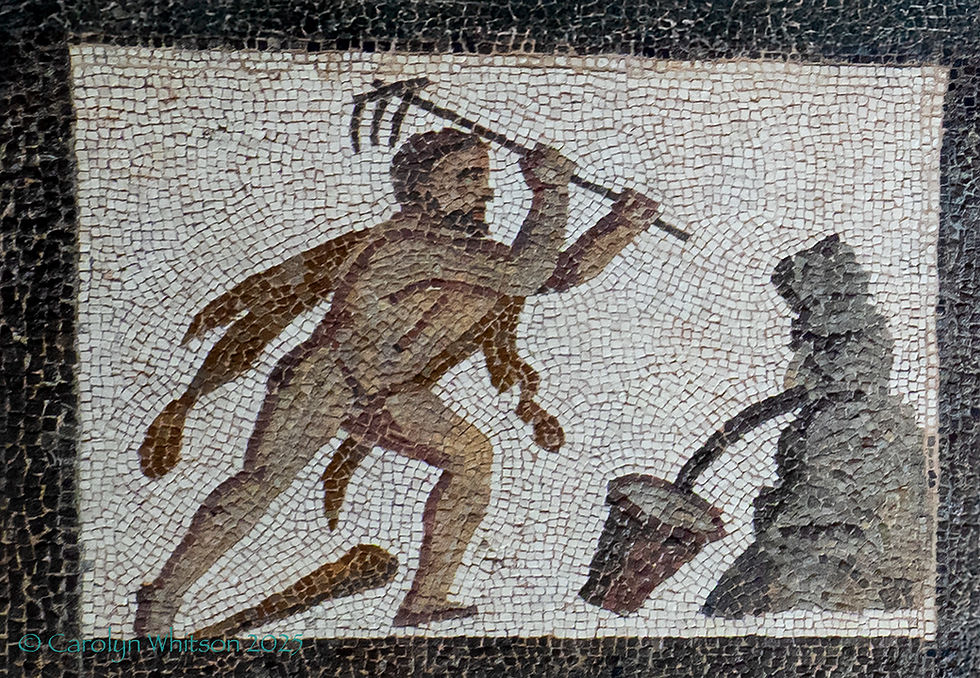
The sixth labor is designed more for humiliation than for danger: King Eurystheus wants to do a solid for another king, Augeus, who has been neglecting his immortal livestock estate for decades. He sends Hercules to muck out the stables. Apparently, immortal livestock produces epic quantities of excrement, and they've been standing around in theirs for 30 years. Hercules may be unafraid of hard work, but he refuses to be exploited in this way for free. So, he haggles with Augeus to do the deed for the price of 10% of the cattle. Augeus reluctantly agrees. Faced with monumental excrement, and inadequate tools, Hercules diverts two nearby rivers to flush out the stables. (I couldn't find any account of what happened to the cattle in this approach, nor of the environmental impact of dumping this much sewage on some unwitting downstream village.) Augeus refuses to pay, citing the fact that Herc was the temporary slave of Eurystheus. Hercules actually takes Augeus to some sort of ancient (and mythical) form of small claims court, and loses. He settles his score, shall we say, extra-judicially, which is usually just fine in myths.
The mosaic artist in the panel above seemed challenged in how to depict this labor. Hercules is holding the muck rake backwards, and wielding it like a club. It looks like the rock (? river? excrement?) thing is spraying into a bucket. If it weren't for the muck rake (and a process of elimination) I would not have guessed this was a scene of the sixth labor. What's sad for Hercules is that Eurystheus tells Hercules that he fails this task because the rivers did all the work. So, our hero still has 8 more tasks to go.
Hercules and the Stymphalian Birds, 540 BCE, British Museum

Some modern problems go back way farther than many of us suspect. If you've ever lived in a place with lots of seagulls or pigeons, you can totally empathize with the poor people of Acadia, who were plagued by a flock of carnivorous birds who dwelt on Lake Stymphalia. The birds not only destroyed crops with their toxic guano, they attacked and attempted to eat townspeople by hurling (hard to visualize) their sharp bronze feathers and attacking them with their bronze beaks. Aided by Athena and Hephaestus, Hercules uses that acidic poison from the hydra's blood and his arrows to solve their problem (and a slingshot, above). This vase is a particularly beautiful representation of the story, with the birds looking like swans or herons. In the mosaic below, it looks more like Hercules is duck hunting.
Hercules and the Stymphalian Birds, Mosaic Floor, 26 CE, National Archeological Museum of Spain, Madrid

Hercules and the Cretan Bull, Etruscan roofing tile, circa 1st century CE, Vatican Museums

As with the Stymphalian birds, this labor is one where Hercules is sent out to clean up yet another public nuisance that was the responsibility of a heedless king. In this case, the King was Minos, who prayed for a sign from Zeus that he was meant to rule Crete. Zeus sent a giant white bull, which was meant to be sacrificed in the god's honor, but Minos thought it was too valuable to kill, and kept it (much to his degradation and doom, as his wife, Pasiphae, really liked the bull, too, and had a son by it: the Minotaur). The father of the Minotaur, this bull, was left to roam the countryside, trampling crops and causing mayhem. With little difficulty, Hercules captures the bull, and brings it home to Eurystheus. He acknowledges the labor is completed, but doesn't want the bull, so Hercules releases it on another unfortunate region--Marathon.
Hercules and the Flesh-Eating Mares of Diomedes, Mosaic Floor, 26 CE, National Archeological Museum of Spain, Madrid

This labor could be counted as another public service to destroy dangerous creatures, but it was framed to Hercules as another theft that would generate yet another powerful enemy for him. He is tasked with stealing the man-eating mares of Diomedes, King of Thrace (not the Diomedes in the Iliad). Thing is, most versions say that Eurystheus neglects to mention that the mares eat people. The versions vary greatly on who gets eaten, but let's go with the ones where Diomedes is the one who becomes horse chow, because that's the most just, since he had no qualms about using other people as pet food. In the happy versions, that feeding tames the mares, and they return to vegetarianism. Herc brings them back and gets to put another task in the "win" column. The legend carries on into history until their descendants are included in the Iliad, and are thought to exist in the time of Alexander the Great.
Hercules Takes the Girdle of Hippolyta, Queen of the Amazons, 500 BCE, British Museum

The ninth labor, in one version, should have been a piece of cake (so, of course, it wasn't). Eurystheus' daughter admires the girdle (belt) of Hippolyta, the Amazon Queen, so the king sends Hercules to steal it. When Hercules gets there, the Amazons welcome him, he explains his situation, and the Queen says, "Hey, no problem! Take it!" But, Hera finds ways to stir up discord, and a battle ensues. Hercules ends up killing Hippolyta, and takes the belt that way, to his great regret.
Other, darker versions (which I find more in accord with how Amazons are represented in most Greek art--as aggressive and scary), to take the girdle of Hippolyta means to depose her. As well, since the girdle is what holds her gown in place, to take the girdle is a metaphor meaning to rape her. In these versions, too, Hera is there to exacerbate conditions. Of all the labors of Hercules, this one is decidedly the ugliest.
I'll stop here, and in the next post finish with the final three labors, one of which includes a cute dog. And, other, extra trouble that Hercules managed to get into.
Note 1: "A man's gotta do, but why this?" is a quote taken from Margaret Atwood's Murder in the Dark, a book of prose poetry from 1983, in the piece titled, "Liking Men."
Note 2: Glare from museum cases is the bane of my existence as a photographer. I've done my best to fix or tone down the problem in several of these photos. If some places look blurry or strange, I apologize.


Brilliant, as usual. My only way to handle all of the reflections from museum cabinets is to use Photoshop's new 'remove reflections' tool. On the whole, it's very effective, although not perfect. Thanks again for a wonderful round-up of Herakles-Hercules.