The Siren Queen: A Medieval Aquamanile in Berlin


Siren Aquamanile, Kupferstichkabinett, Berlin, circa 1230
Maybe it was the dramatic staging, but this piece changed my narrow mind about a whole genre of medieval art that previously I had just passed by with a shrug of the shoulders as I moved on to shinier objects. At the Kupferstichkabinett, or the Museum of Prints and Drawings in Berlin, there is a a large room of medieval treasures, all products of what is now called Germany and Austria. The item above is an aquamanile: a pitcher, generally used for pouring water over hands as one washes them. They are Islamic in origin, and became common in usage in Europe initially as ritual items for priests purifying themselves before the sacrament of the eucharist. Over time, they were also prestige items in noble and wealthy households.

This aquamanile captivated me because I found it strikingly beautiful--and, because I'm into sirens in medieval art. Medieval sirens are more typically depicted as what English speakers call "mermaids," but in medieval Europe, particularly in monasteries with libraries where classical texts were read, sirens were understood in the Ancient Greek sense, as monstrous women with bird bodies who enticed sailors to their doom by singing seductive songs which lured their ships onto dangerous rocks near their high perch.
The Berlin Siren Aquamanile has a regal demeanor--indeed, she wears a crown with a fleur-de-lis, which was/is the symbol of the House de Bourbon (currently the Spanish Crown, but was French (and English) in the Middle Ages). She wears her hair in braids, unlike the images of sirens used in churches to warn about the dangers of lust and vanity.
Siren carving, Sens Cathedral, 15th century

A carving of the more typical medieval siren can be found in Sens Cathedral (above). The fish body is in the style of hybrid creatures that developed out of Mediterranean religions much earlier, and became more customary for sirens than the bird body. The fish body was suggestive of fertility, but in this instance, in Christian uses of the siren, the siren offers a false promise of fertility--a lust that is fruitless. Her sexual promise cannot be missed in her prominent breasts and luxuriant hair (loose hair and female nudity in medieval art were reserved for fallen women like Eve and Mary Magdalene in Christian iconography). The comb and mirror indicate that the siren is focused on her own beauty, and therefore is vain. In this sense, the woman siren is very much to blame for the desire she provokes in the male sinner she tempts.

By contrast, you can see that the artist who designed this siren has, for reasons unknown, fashioned this creature to appear chaste and haughty.

The minimalist construction of this aquamanile is quite elegant. The base is balanced on her two delicate bird feet and the gentle swooping-down of the tips of her wings. The light contact points give the pitcher an airiness that belies the fact that this is a sturdy metal object meant to be full of water. Her tail arches back toward her head to form the handle. I don't have the vocabulary for it, but the counterbalance of the arch of the tail in opposition to the two wings really makes the refinement of the piece. Please scroll up and down to compare it to the handles of the other objects here--it is by far the most graceful.
Aquamanile in the form of a Centaur, with Piper, Kupferstichkabinett, circa 1230 (copper facsimile, 19th century, for university study)

The Siren Aquamanile has her pour spout in her forehead, and the centaur, above, has his in his drum. I'm puzzled by the additional holes in his drum: perhaps the idea was to have more of a sprinkler effect when pouring water over the hands? In both cases, though, I cannot see where one adds the water prior to use. Maybe a funnel was used to pour the water in through the spout. That seems inefficient and awkward. [ Addendum: Looking more closely after posting 2 hours ago (oops), I believe the back of the siren's crown has fasteners for a lid, so perhaps the place to pour in the water was in the head of the piece. I just was not tall enough to see the top of the aquamanile to notice.]
Griffin Aquamanile, Louvre Museum, Lower Saxony, circa 12th century

This griffin aquamanile is about a century younger than the previous examples. It originally had a lid to cover the opening where one poured in the water (which exited through the creature's mouth). You can see the fastener for the missing lid on the griffin's tail.
Lion Aquamanile, Louvre Museum, Lower Saxony, circa 1400

Lions were enormously popular subjects for aquamaniles, perhaps for their versatile symbolism. In Christianity, they can represent Christ himself. But, as you can see from the sampling in this post, fanciful beasts of all kinds were popular subjects. The variety and whimsy put me in mind of the staggering diversity of British teapots in the last century or so. You can't see it from the angle its placed in its cabinet, but the handle of this aquamanile is in the shape of a leaping hound.
Dragon Aquamanile, Metropolitan Museum of Art, The Cloisters, NYC, Northern Germany, circa 1200
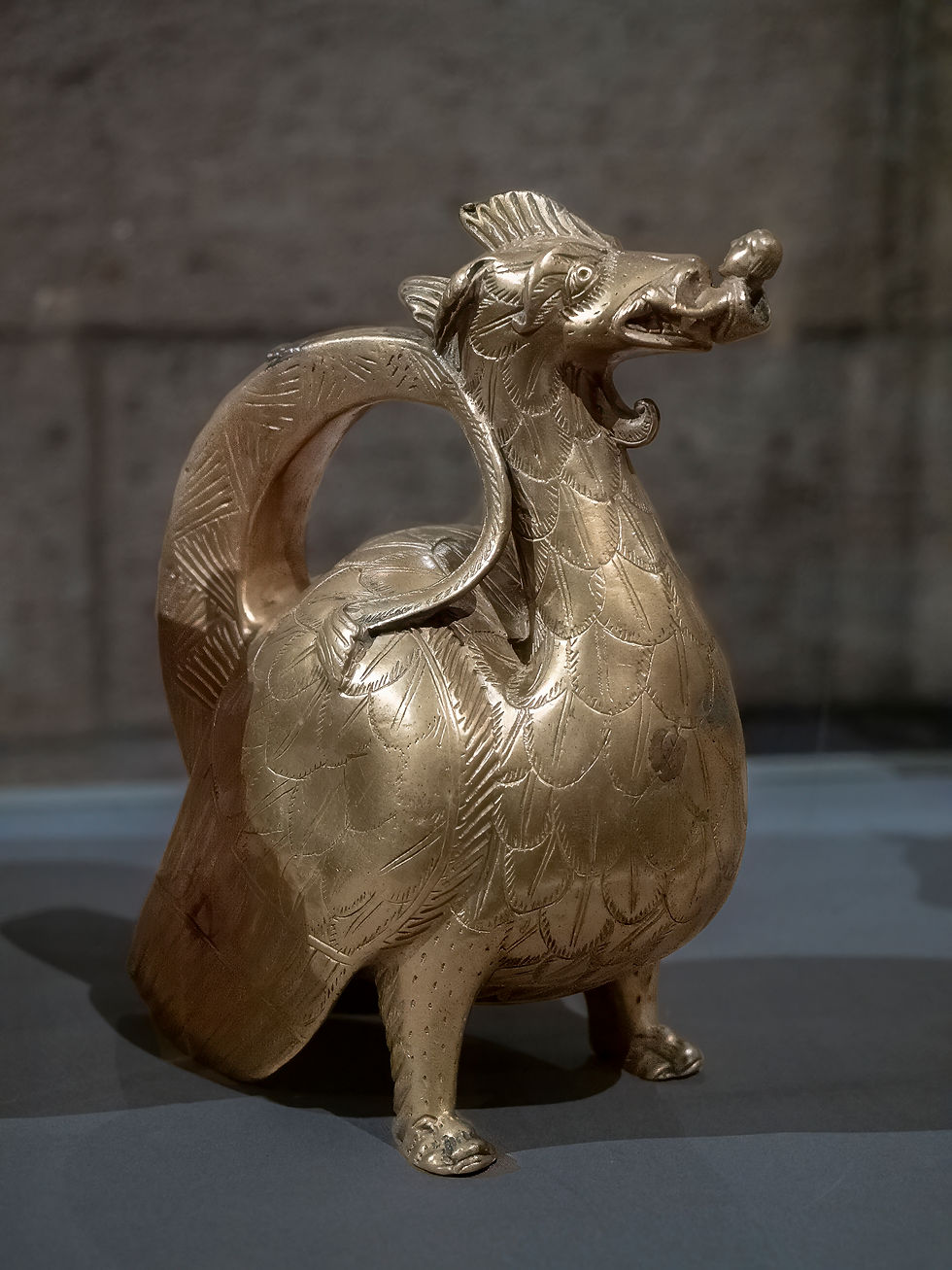
Here is a dragon-shaped aquamanile. The spout is somewhat obstructed by the little person he is attempting to devour. I can't say so decisively, but I keep thinking that the dragon's feet have little faces on them.
Lion Aquamanile, Minneapolis Institute of the Arts, Iberian Peninsula (modern Spain/Portugal) 11th-12th centuries

As stated above, the aquamanile style had its origins in Islamic art, starting in the 7th century. The prayer practices in Islam require ritual cleansing of the hands and feet before beginning. This precious lion aquamanile is very small, only 4.5 inches (12.1 cm) high, which makes it seem scarcely large enough for the job. The curator at the Minneapolis Institute of Art proposes that because of its scale it may have been more symbolic or decorative than utilitarian. It's a masterpiece of gold-smithing, incredibly delicate and detailed.

It is designed such that the water would have poured out over its tiny gold tongue. The other German-workshop-made examples in this post are composed of differing alloys of copper and zinc, accounting for the differences in color and shine. Gold turns the Iberian aquamanile into a more glamorous, intricate creature (given that brass is less malleable for detail work), but not one practical for daily use.


I see a dragon, so of course I am going to have something to say about it. :) First, astounding photos as always. I am grateful to see you still posting years after being your student (R. Bishop), and hope that your travels are fairing well. Second, your very stern siren does seem like she has been progressed from maiden to matron. She absolutely is judging everyone who isn't maintaining good physical and moral hygiene. Third, the dragon and its feet. It's not just you. I do see grotesques (or maybe serpents?) there but the features may be worn by time or use or both. Looking forward to more.
Really these museums should be paying you for taking and distributing such amazing pictures with such entertaining and enlightening commentary. How's this for Coincidences You Can't Believe? I have also never been smitten by aquamaniles, particularly from the 13th century.
I love your lady, but I think I love the lion more. And the mermaid, who reminds me of Alexander the Great's nosy sister, who WILL keep assaulting ships in the Aegean to see how her brother's doing... 🤩🤩🤩